
LeanSignal · Interoperable data & systems architecture Precision Control.
FabrIQ · Interoperability technology

Make fragmented systems operate as one environment.

FabrIQ is designed for organisations where information is spread across different applications, platforms, networks and organisational boundaries. It improves how those systems participate in a shared operational environment without requiring them to become the same system.

FabrIQ at a glance

A high-level view of the problem and effect.

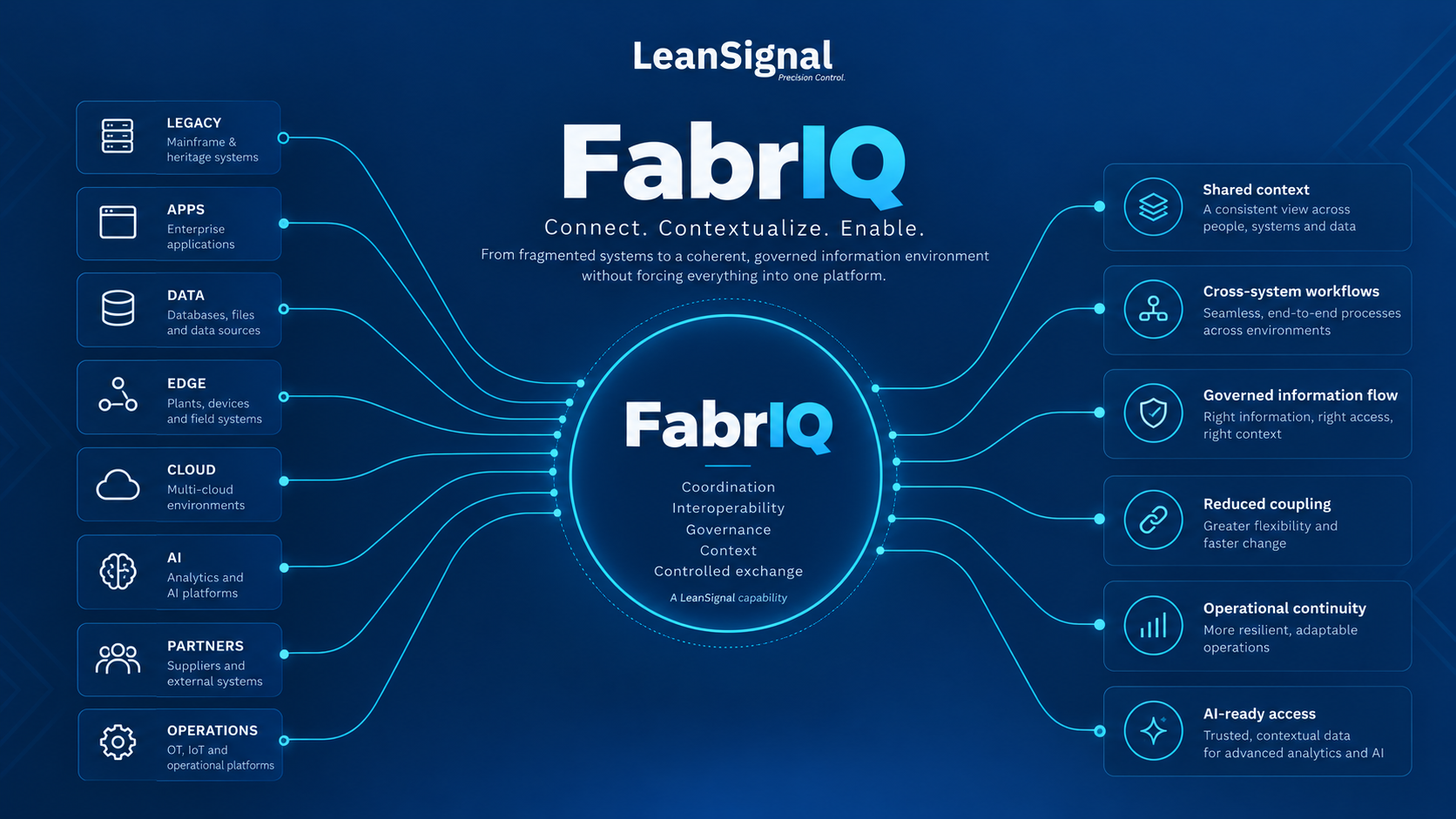
The visual below is intentionally illustrative rather than implementation-specific. It shows the role FabrIQ plays between fragmented systems and a more coherent, governed information environment.

High-level FabrIQ visual showing fragmented systems connecting through FabrIQ to produce shared context, cross-system workflows, governed information flow, reduced coupling, operational continuity and AI-ready access.

At a high level, FabrIQ helps existing systems participate in a shared information environment with improved context, governance and interoperability, without requiring them to become one platform.

The problem

Integration grows. Coherence does not.

Large environments accumulate connections faster than they accumulate control.

Information is often available somewhere, but not where it is needed, in the right context, under the right policy or at the right time. New integrations solve individual connections while increasing dependency, duplication and operational complexity across the wider environment.

Fragmented information
Point-to-point integration
Hidden dependencies
Inconsistent policy
Slow change
Operational friction
What FabrIQ changes

Interoperability without forcing everything into one platform.

Existing systems can remain different while participating in a more coherent information environment.

FabrIQ introduces a controlled interoperability layer around existing systems so information can move across boundaries with greater consistency. The emphasis is on preserving context, governance and architectural independence while reducing the amount of bespoke integration needed between individual systems.

Cross-system interoperability
Consistent information context
Reduced integration coupling
Policy-aware exchange
Distributed participation
Easier architectural change
Operational effect

Make information usable across system boundaries.

The objective is not more connectivity. It is more useful, governable and resilient information flow.

FabrIQ is intended to help organisations reduce the gap between where information originates and where it must be used. That can support operational teams, automation, analytics and decision systems without making each new use case dependent on another bespoke integration programme.

Information where needed
Less manual handover
Fewer bespoke interfaces
Improved change isolation
How it fits

A shared layer, not a replacement programme.

FabrIQ is designed to work around existing technology rather than require wholesale replacement.

At a high level, FabrIQ provides a common way for distributed systems to participate in information exchange while retaining their own implementation, ownership and operational responsibilities. The underlying architecture is deliberately abstracted from this public description.

Legacy systems
Cloud platforms
Edge environments
Partner systems
Designed for

Environments where system boundaries cannot become operational boundaries.

FabrIQ is relevant where multiple systems, domains or organisations must cooperate while maintaining appropriate autonomy, governance and control.

Defence & mission systems
Government
Critical infrastructure
Large distributed enterprises
FabrIQ

Start with the interoperability problem, not the product.

LeanSignal can assess whether the problem is architectural, organisational or technical before determining where FabrIQ is relevant.